
Suffolk County Court Records After Arrest
After a Suffolk County arrest, the first record may be a booking or custody entry handled through the Suffolk County Sheriff's Office under Sheriff Dr. Errol D. Toulon, Jr. The court record is different. It begins when the case reaches criminal court and a charge document is filed or presented. That is where the formal count, court part, docket or case identifier, calendar date, warrant activity, bail order, and final disposition are tracked. The District Attorney's Office, led by Raymond A. Tierney, reviews the arrest facts and decides how the prosecution will proceed.
The jail side answers whether the person is in Riverhead or Yaphank custody, whether bail can be posted, and whether a hold blocks release. For that custody track, use Suffolk County jail inmate records. Booking photographs and New York's limits on public mugshot release are treated separately on the Suffolk County jail mugshots page. A court record after a jail arrest is the case track: what was filed, what changed, what remains pending, and what was resolved.
New arrests do not always appear in a court portal at the same pace as jail intake. A person can be booked before the public court index reflects the case. The reverse can also happen after release, because a criminal case may remain pending after jail custody ends. That is why Suffolk County court records after an arrest should be checked through both court and custody sources when timing matters.
Find Suffolk County Court Records After Arrest
The official criminal case portal for New York is WebCriminal, also called WebCrims. The visible interface shows case-search paths for Case Identifier, Defendant, and Court Calendar. The full tool requires JavaScript, so the safest search method is to start with the person's legal name, then use a case or docket identifier if one appears on release papers, arraignment paperwork, or a court notice.
The Suffolk County 10th Judicial District page is the local court-administration source. It includes court finder filters for case type, court type, county, and town or village courts. That matters in Suffolk County because a misdemeanor, violation, preliminary felony matter, sealing request, certificate of disposition, or local court file may route through a different court than a later felony prosecution.
- Confirm custody and bail first if the person is still in jail. VINE New York or Suffolk Central Records can answer custody questions that WebCriminal does not answer.
- Search WebCriminal by defendant name after arraignment or filing. Very new arrests may need time before a public case record appears.
- Use the Case Identifier tab when a docket, case, or ticket number is known. This is often cleaner than a broad name search.
- Check the Court Calendar path when the goal is an upcoming appearance, not a complete history.
- Contact the relevant court clerk for certificates of disposition, older files, or records that are not shown in the public portal.
The court image below comes from the New York WebCriminal defendant search page, the state portal used for public criminal case searches.
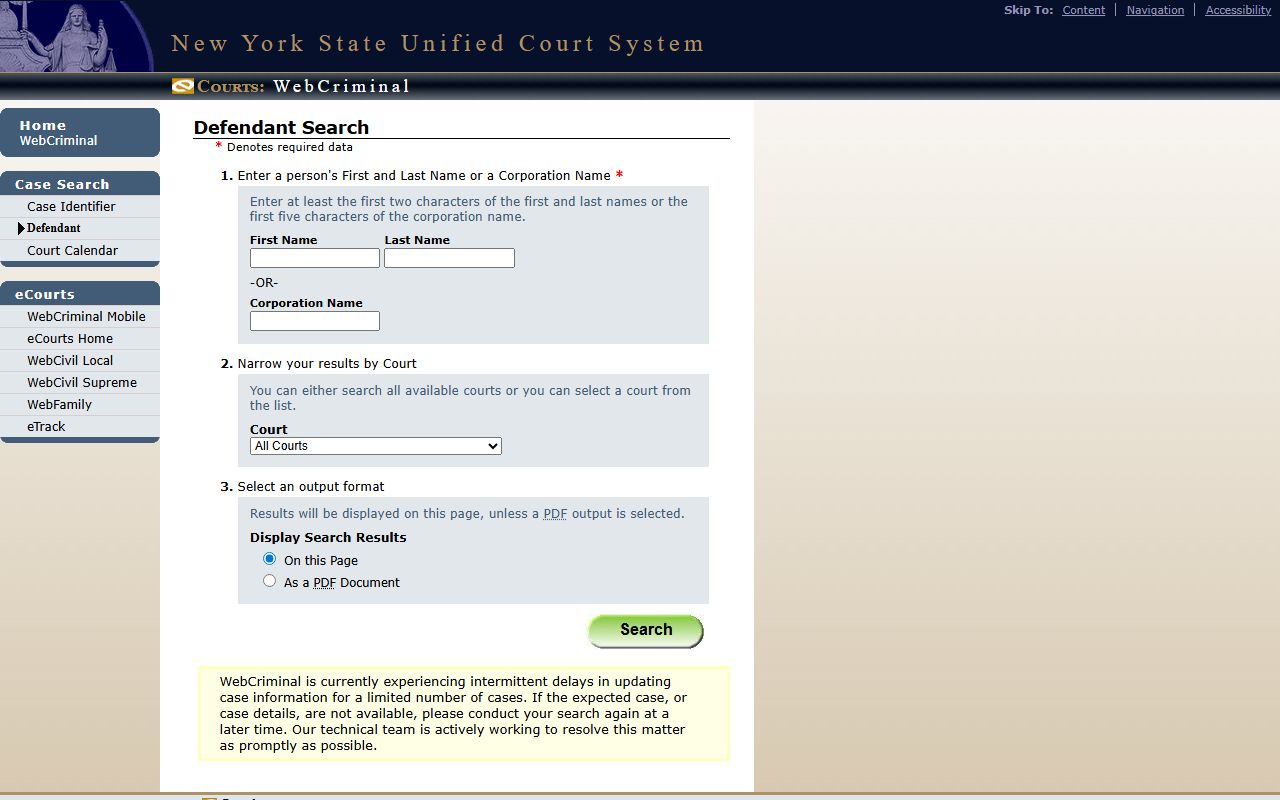
WebCriminal is for court case information. It is not a Suffolk County jail roster, mugshot gallery, or proof that the person is still in custody.
WebCriminal Court Records Search Fields
A completed public sample Suffolk County case record is not available from the raw WebCriminal interface because the tool is JavaScript driven. The visible official tabs still define the main search routes. Use the table as a field guide, not as a promise that every older, sealed, local, or recently filed case will appear in the same way.
| Field Label | Type | Required | Notes |
|---|---|---|---|
| Case Identifier | Tab or search path | Alternate | Best when a docket, case, summons, or ticket identifier is known. |
| Defendant | Tab or search path | Alternate | Use for defendant-name searches after a case has reached court filing or arraignment. |
| Court Calendar | Tab or search path | Alternate | Useful for checking public calendars by court and date where available. |
| Search or Submit | Button | Not applicable | The exact button label may vary inside the live application. |
| WebCriminal Mobile | Linked mobile tool | Optional | Use when the desktop interface is hard to use on a phone. |
For official statewide criminal-history access, use New York DCJS record review. A DCJS RAP sheet is fingerprint based and is not the same product as a public WebCriminal case search.
Suffolk County Court and Arrest Routing
An arrest can move through more than one local court stage. New York court sources for Suffolk County list criminal certificates of disposition, criminal record searches, felony preliminary processing and hearings, misdemeanor or violation matters, parole violations, post-sentence work, resentencing, and criminal sealing as separate service categories. A felony arrest may begin in a local criminal court, then move after grand-jury action. A misdemeanor can remain in District Court or another local criminal court depending on the place and charge.
The local court-administration image below comes from the New York Unified Court System Suffolk County 10th Judicial District page.
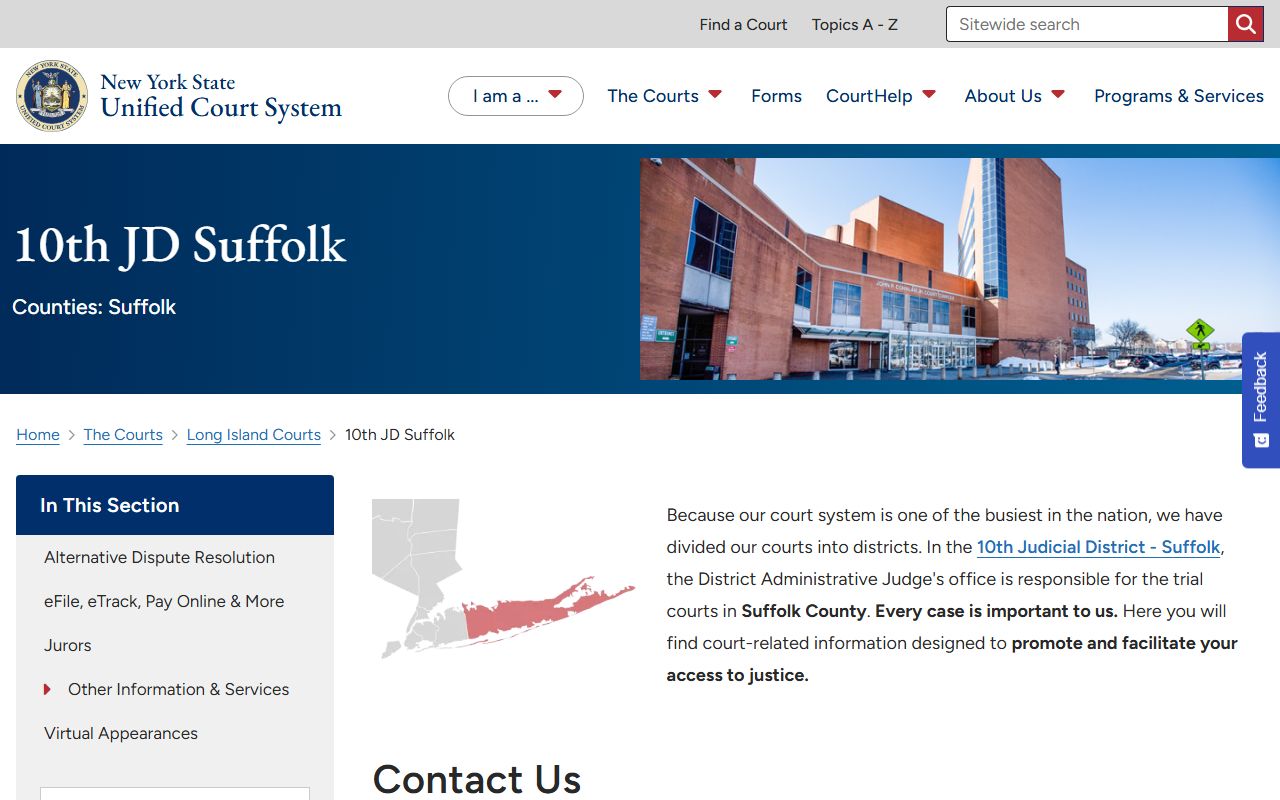
The district page is most useful when the case appears to involve a town or village court, a certificate of disposition, or a clerk request rather than a simple public case search.
Suffolk County Arrest Charge Documents
The charge document is the bridge between arrest and court record. Police paperwork may describe arrest conduct, but the prosecution track depends on what is filed or pursued in court. In New York, the label can vary by offense level and case posture. A misdemeanor can proceed by information or related accusatory instrument. A felony may begin with a felony complaint before grand-jury action. More serious felony prosecutions may move by indictment, and some cases can proceed by superior-court information when allowed.
| Document | Who Uses It | Common Role After Arrest | What to Check |
|---|---|---|---|
| Complaint or felony complaint | Police and prosecutor through criminal court | Starts or supports the first court stage after arrest. | Charge count, offense level, factual basis, and next appearance. |
| Information or prosecutor's information | Prosecutor | May replace or support prosecution in local criminal court. | Whether the count changed from the booking or first complaint. |
| Indictment or superior-court information | Grand jury or superior court process | Moves many felony cases into the higher prosecution track. | New indictment number, count list, arraignment, and plea status. |
Do not treat the first booking charge as final. The Suffolk County District Attorney's Office can decline a count, add a count, reduce a count, or pursue a different document after reviewing police reports, witness information, and legal sufficiency.
Suffolk County Court Charge Status
Charge status is the part of Suffolk County court records after a jail arrest that most often changes. A charge can be pending at arraignment, amended later, reduced during plea talks, dismissed by the court, or disposed by plea or verdict. A court record should be read count by count, because one count may be dismissed while another remains open or ends in conviction.
| Status | Meaning in a Court Record | Reader Caution |
|---|---|---|
| Pending | The case or count is still open. | Future court dates, bail terms, and warrant status can still change. |
| Amended | The wording, count, or charge basis changed. | Compare it with the first complaint before assuming the arrest charge stayed the same. |
| Reduced | The charge was replaced by a lower offense. | A reduction is not the same as a dismissal. |
| Dismissed | The charge or case ended without conviction on that count. | Check whether sealing applies under New York law. |
| Disposed | A final court outcome has been entered. | Read the exact disposition, not just the word disposed. |
| Warrant ordered | The court issued a warrant, often after a missed appearance. | Confirm with the court or counsel before relying on an online entry. |
Note: A jail release entry can be accurate while the court charge remains pending.
Bail Orders After Suffolk County Arrest
Bail is a court order that the jail processes. The Suffolk County Sheriff's bail page tells families to contact Central Records at (631) 852-2241 and says that office is available 24 hours a day, 7 days a week. A person posting bail must know the incarcerated person's date of birth. The sheriff also warns that the on-site process will likely take several hours, so a court record showing bail does not mean immediate release.
| Bail or Release Item | How It Connects to Court Records | Suffolk County Jail Step |
|---|---|---|
| Recognizance or non-monetary release | The court permits release without cash bail, sometimes with conditions. | Confirm any remaining hold before leaving the court or jail process. |
| Cash bail | The court sets an amount that can be paid to secure return to court. | Riverhead accepts bail 24/7; Yaphank has posted daily hours. |
| Bank or cashier check | The court amount may be paid by accepted check form. | Checks must be verified during normal banking hours and made payable as the sheriff requires. |
| Credit card bail | The same court bail amount is paid through a third-party card process. | The sheriff lists a 7% charge and a total card-charge cap including that charge. |
| Bond | A surety or bond instrument may satisfy the court order when allowed. | All bonds are accepted only at Riverhead. |
A hold can block release even when bail is posted. Ask Central Records whether there is another warrant, detainer, parole issue, state-ready transfer, federal custody matter, or other court order before spending time or money on bail.
Suffolk County Warrants and Court Records
No official Suffolk County Sheriff's Office public criminal warrant search appears in the official sheriff pages. The sheriff contact page lists Civil Enforcement Bureau contacts, including summonses and warrants of arrest, but that listing appears in a civil-enforcement context. It should not be treated as a criminal warrant hotline without direct verification.
For criminal case warrants, start with the court that issued the warrant or the public case record if it is visible. Bench warrants often arise from missed court dates or failure to comply with a court order. An arrest warrant can lead to booking at Riverhead or Yaphank once the person is taken into custody. Before custody, the jail may have no current booking record.
- Bench warrant
- A warrant usually tied to a missed court date or failure to obey a court order.
- Arrest warrant
- A court order authorizing law enforcement to take a person into custody.
- Detainer
- A notice or hold from another agency that can affect release after bail is posted.
- Remand
- A court order keeping the person in custody without release on bail at that stage.
Suffolk Court Charges vs Convictions
An arrest, a charge, and a conviction are not the same event. A person arrested in Suffolk County is presumed innocent unless guilt is later entered by plea or verdict. Court records after a jail arrest can show accusations before any final result, so a search result should be read by stage and status.
| Point of Comparison | Charge | Conviction |
|---|---|---|
| Legal stage | An accusation filed or pursued in court. | A final finding of guilt by plea or verdict. |
| What it proves | That the case included an alleged offense. | That guilt was entered for a specific offense. |
| Can it change? | Yes. It can be amended, reduced, added, or dismissed. | It may later be appealed, vacated, sealed, or otherwise limited by law. |
| How to verify | Read the charge list and current status. | Request a certificate of disposition from the court when official proof is needed. |
Sealed Arrest Records in Suffolk County
New York uses sealing rules more often than true expungement for criminal cases. Criminal Procedure Law section 160.50 governs sealing when a criminal action ends in favor of the accused. Criminal Procedure Law section 160.55 covers sealing after some noncriminal convictions. Public access may also be limited by privacy, juvenile, youthful offender, or active-investigation rules.
| Point of Comparison | Sealed | Expunged |
|---|---|---|
| Basic meaning | Public access is restricted by statute or court order. | The record is treated as removed or destroyed in systems that allow true expungement. |
| New York practice | Common term for favorable termination and other eligible results. | Not the normal New York term for most criminal-case relief. |
| Public lookup effect | The case may disappear from public search or show limited information. | Do not assume expungement exists without a specific court or statute basis. |
| Official proof | Ask the court clerk or counsel about sealing status and certificates. | Use official court or DCJS channels if a record-review question remains. |
Note: A dismissed Suffolk County charge may still need time and proper processing before public search results change.
Suffolk Court Records Public Access Limits
New York's Freedom of Information Law is in Public Officers Law Article 6. Public Officers Law section 87 addresses access to agency records, and Public Officers Law section 89 includes procedures and privacy rules. These laws do not make every arrest, booking, court, or law-enforcement record public in full. They create access rights, exemptions, and redaction rules.
The Suffolk County Sheriff's FOIL page is the route for incarceration records held by the Sheriff's Office, generally for men and women incarcerated at Suffolk correctional facilities. It is not the right office for police reports, accident reports, 911 transcripts, or official criminal-history review. Court records after an arrest should be requested through the court when a clerk-held file or certificate is needed.
Important: Do not use informal arrest or court searches for employment, housing, credit, insurance, or other FCRA-covered screening decisions.
Older Court Records After Arrest
Older Suffolk County court records may require a clerk request even when the arrest was real and the case once appeared online. WebCriminal may not show every older record, every sealed case, or every record stored under a local court path. For official proof of outcome, a certificate of disposition from the court is usually more useful than a screen view.
If the question is statewide criminal history, use DCJS fingerprint-based record review. If the question is current county custody, use VINE New York or Central Records. If the question is state prison after sentence, use the New York State Department of Corrections and Community Supervision incarcerated lookup. Suffolk County court records after a jail arrest sit between those systems, so the source must match the question.